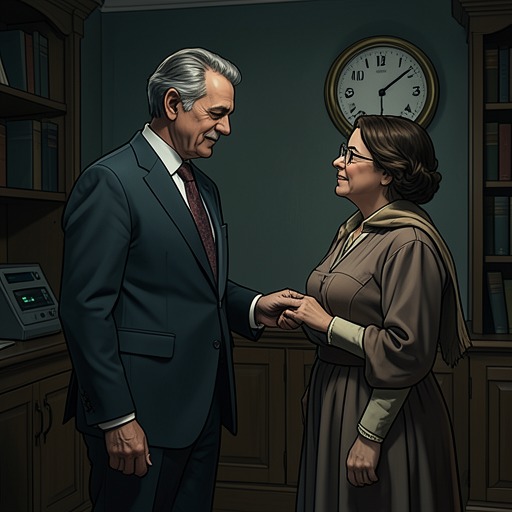
Leona Cassiani
Love in the Time of CholeraLeona Cassiani is Florentino Ariza’s most capable ally in the River Company of the Caribbean and the woman the narrative calls the true woman in his life, though the two never become lovers. First encountered on a mule-drawn trolley, she is repeatedly misread by Florentino: he initially assumes she sells sex, later overlooks the love she has held for him, and finally learns that devotion can endure without possession. Her intelligence transforms the company’s neglected General Section, helps advance Florentino’s career, and gives their long association a form more durable than the romance he keeps pursuing elsewhere.
Identity and First Encounter
Florentino first sees Leona on a trolley at five in the afternoon. He senses her gaze before looking up and finds her watching him steadily from the far end of the carriage. Her boldness leads him to a contemptuous conclusion: he decides she must be a prostitute, a judgment shaped by his conviction that paying for love is beneath him. The error exposes how quickly he converts a stranger’s look into a story that suits his own categories.
After getting off at the Plaza of the Carriages, Florentino hurries through the market, then hears her heels behind him in Oil Lamp Alley. She follows as he changes direction; he stops, turns, and blocks her way with his umbrella. The encounter does not immediately correct his assumptions. Instead, the episode sets up the distance between Leona’s actual character and the role he assigns her before he knows her.
Work and Influence at the River Company
Leona enters the narrative’s account of the company as an employee of its General Section, a repository for minor problems other departments have discarded. When Uncle Leo XII inspects the department, she remains silent in the meeting, not from negligence but from respect for its hierarchy. The next day she sends Florentino a memorandum explaining that the section’s supposed work is not a coherent function at all: it is a dumping ground. Rather than reorganize it, she recommends abolishing it and returning each problem to the department that generated it.
The proposal’s strength lies in its plain diagnosis. Uncle Leo XII had been unable to find a solution during three hours of questioning and discussion; Leona’s memorandum identifies why the problem resists a conventional fix. After speaking with her privately for two hours, he accepts her recommendation. He eliminates the General Section and creates a new position for her, without a formal title or defined duties, that effectively makes her his personal assistant. He begins calling her my namesake Leona, while Florentino truthfully tells him he found her on the trolley.
Uncle Leo XII then jokes that Florentino should return to the trolley and find more women like her. The next day, Florentino discovers that the carriage assigned to him six months earlier has been taken away so he can search for talent. Leona, meanwhile, moves from careful silence to command of the company’s practical affairs. After her first three years, she has revealed what she had been holding back; within three more she has taken control of everything, and four years later stands just below the General Secretaryship. She declines that final step because it would leave her only one rank below Florentino, whom she continues to let believe he directs her.
In reality, Florentino advances through the Board of Directors by following her suggestions. Leona handles secrets with exceptional skill and knows how to appear where she is needed. Her manner is dynamic yet quiet, marked by a wise sweetness; when necessary, she can act with an iron resolve, though never for her own advancement. She clears obstacles from Florentino’s path, even when that requires harsh measures, because gratitude has joined her will to power to his ambitions. Her work protects his rise from the traps laid by his secret enemies, while he fails to see how much of his own success depends on her judgment.
Friendship, Love, and Refusal
For years, Leona’s work and friendship run alongside Florentino’s unspoken romantic hope. When he finally asks her to be his lover, she removes her glasses without surprise and laughs. She tells him she has been waiting ten years for him to ask. By then, however, the opportunity he imagines has passed: she had been present on the trolley and in the chair where she now sits, but life has carried her beyond it. The age difference, once in Florentino’s favor by twenty years, has become decisive to her; she says she would feel as if she were going to bed with the son she never had.
Her refusal is not a denial of love. Leona has loved Florentino so deeply that she chooses a painful honesty over deceiving him, even after enduring sordidness and dirty tricks on his behalf. Florentino initially suspects that her no may not be final, but, wary of repeating his mistake, he withdraws without protest. The cloud between them dissipates without bitterness. He comes to understand that a woman can be his friend without becoming his sexual partner—a recognition Leona’s answer makes possible, though it arrives too late to fulfill his old hope.
Their relationship is therefore not a postponed affair that finally yields to circumstance. Leona’s devotion takes shape through labor, discretion, and friendship, while Florentino’s desire remains directed toward Fermina Daza. He can walk beside Leona as though they were old sweethearts, yet still keep his deepest longing from her. The affection between them is real, but it does not erase the difference between her loyalty and his romantic fixation.
A Companion Through Later Life
Leona accompanies Florentino to the opening of the silent film Cabiria, whose reputation rests on dialogues by Gabriele D’Annunzio. In the crowded open-air patio, she watches the film intently while Florentino nods off. A woman behind him remarks on the film’s length, and he recognizes Fermina Daza’s voice. The chance encounter revives his longing and leaves him walking through the old city with Leona instead of taking her home in the carriage.
As they walk, Leona thinks about the film and Florentino about his misfortune. He again summons his strength not to reveal his love for Fermina. They move through the sleeping streets like unhurried old sweethearts, their intimacy expressed in shared company rather than confession. At Leona’s door he asks to come in for brandy. Ten years earlier, she had warned him that if he entered at that hour he would have to stay forever; this time she invites him in without asking for promises. Her house has changed since the Sundays he once spent there with her family: her parents are dead, her brother has made his fortune in Curaçao, the furniture has been moved, and even the cat does not recognize Florentino. The alterations make him feel erased from a place he had once considered his own.
Leona’s place in his life also becomes inseparable from the River Company’s succession. When Uncle Leo XII says that, if he were fifty years younger, he would marry his namesake because he could imagine no better wife, Florentino fears that his own long labor may be frustrated at the last moment. He would rather abandon everything than fail Fermina. Uncle Leo XII does not press the matter; at ninety-two, he names Florentino his sole heir and retires. Six months later, the Board unanimously appoints Florentino President and General Manager. At the handover, Uncle Leo XII identifies finding a worthy successor, despite destiny’s obstacles, as one of the two providential events of his life. Leona’s advancement of Florentino has helped make that succession possible.
Care, Loss, and Narrative Significance
In Florentino’s later years, Leona’s loyalty becomes physical care. When he is immobile, she helps him bathe and change his pajamas every other day, administers enemas, holds the portable urinal, treats the bedsores on his back with arnica compresses, and gives him the massages his doctor recommends. América Vicuña relieves her on Saturdays and Sundays. Leona’s care is practical and sustained: the same woman who once managed the company’s unresolved problems now tends to Florentino’s bodily needs as illness and age narrow his world.
Leona also sends Florentino an urgent telegram while he is traveling with Fermina. It reports that América Vicuña has died. He learns from Leona that América, devastated by failing her final examinations, drank laudanum stolen from the school infirmary. Florentino suspects that the account is incomplete, but América left no explanatory note, and Leona has informed the family, who are traveling from Puerto Padre for the funeral. He suppresses the anguish by trying to erase the memory, which later returns like the pain of an old scar. In this episode, Leona is the trusted link between the news, Florentino, and the family, even as she cannot spare him the knowledge of the death.
Her work also confronts him with the consequences of his inattention to the river. During a voyage, Florentino receives reports of the Magdalena River’s devastation, but for years barely reads them, reassuring his associates that oil-powered boats will arrive before the wood is gone. On another voyage, he finally listens to Captain Samaritano’s account of the company’s imbalance between cargo and passengers and asks whether a ship could travel without stopping or taking on either. The Captain says this is only hypothetically possible: the company’s contracts are difficult to evade, but a cholera case could force quarantine and the yellow flag. Florentino’s habitual answer to operational problems has been that Leona can handle them better than he can; here, at last, he attends to the Captain himself. Her competence has long enabled his delegation, but the novel also shows the limits of a life in which he has allowed work and desire to distract him from the river’s decline.
Leona’s significance rests on the combination of capacities that Florentino is slow to recognize. She sees how an institution actually functions beneath its official labels, converts that insight into an effective reorganization, and quietly shapes the career of a man who believes himself to be directing events. In private, she can love without demanding possession and refuse a belated romance without ending a friendship. Her first appearance as a woman Florentino misclassifies becomes an enduring counterpoint to his assumptions: she is neither a brief sexual encounter nor a lost lover, but the shrewd colleague and steadfast companion whose care and judgment accompany him across much of his life.